Klyvara
Halo Archive
Halo Archive
Couldn't load pickup availability
Self-paced learning overview
- 📥 Digital file available after purchase
- ♾️ Long-term availability
- 🔒 Secure checkout
- 🗓️ Content updated in 2026
1. Problem Statement
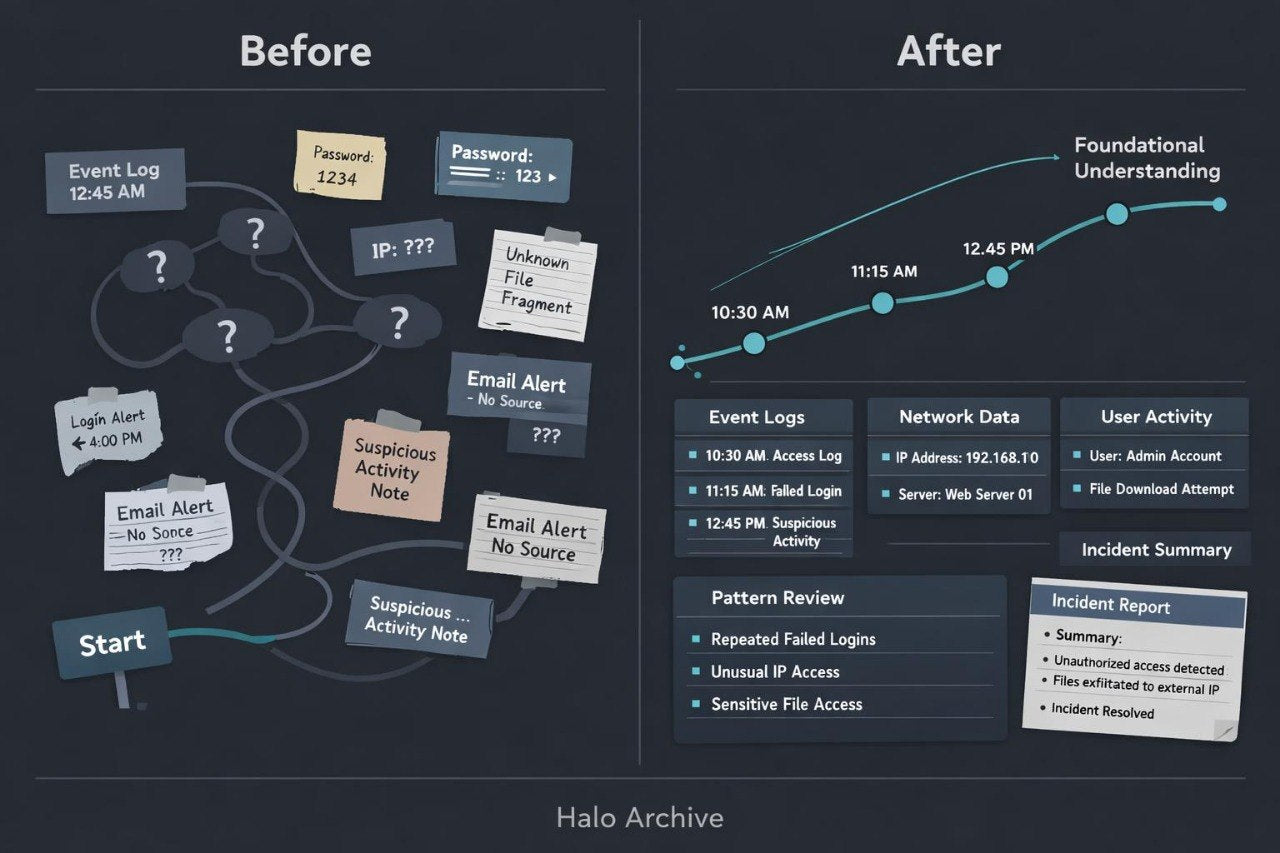
Struggling to understand a digital event when the necessary details are scattered across separate records? You’re not alone: timestamps, messages, setting changes, notes, and participant actions are often documented independently. This can cause important context to disappear while the same event is described in several inconsistent ways. Disorganized materials make it difficult to compare similar situations and identify recurring signals. Without a clear recordkeeping structure, reconstructing an event sequence and preparing an accurate summary becomes more complicated.
2. Solution
This course will teach you how to organize information about digital events into a consistent record system. You will examine methods for classifying materials, building timelines, identifying sources, and assigning importance levels. The materials explain how to preserve context and separate factual details from working assumptions. Practical tasks help you compare records, identify connections, and prepare neutral summaries. In the final assignment, you will create a personal archive structure for an extended learning scenario.
3. What’s Inside
Module 1: Security Record Foundations
You will examine the types of records used when reviewing digital events. The module covers timestamps, sources, descriptions, statuses, related actions, and assigned responsibilities.
Module 2: Information Classification
Learners organize materials by type, sensitivity, source, and relevance to an event review. You will create a category table for repeated use throughout the course.
Module 3: Source and Context Tracking
This module explains why every record should include its origin, date, and related context. You will learn to label incomplete information and questions requiring further examination.
Module 4: Timeline Reconstruction
You will work with fragmented records and restore the correct sequence of events. Exercises include conflicting timestamps, missing stages, and actions occurring at the same time.
Module 5: Connected Record Analysis
Learners connect records through shared details such as time, source, information type, participant, or outcome. The module includes exercises for creating relationship maps.
Module 6: Pattern Review
You will compare several situations and identify recurring signals. Particular attention is given to distinguishing a meaningful pattern from an unrelated coincidence.
Module 7: Incident Documentation
This module covers the structure of a digital event document: concise description, confirmed facts, completed actions, open questions, and later steps. You will prepare two learning documents.
Module 8: Archive Structure Design
You will create a logical system of folders, categories, names, and statuses without referring to named third-party software. The purpose is to make materials understandable during later reviews.
Module 9: Review and Retention Decisions
Learners consider which records should be retained, reviewed, updated, or removed under established rules. The materials explain the importance of consistent retention periods.
Module 10: Complete Archive Exercise
In the final assignment, you will receive a collection of fragmented records, organize them, build a timeline, mark connections, and prepare a closing document.
4. Who Is This For?
✅ This plan is suitable if you:
- want to organize records related to digital events;
- work with numerous messages, notes, or reports;
- want to reconstruct event sequences more carefully;
- already understand foundational digital risk review;
- are prepared to work with tables, diagrams, and learning scenarios.
❌ This plan may not suit you if you:
- are seeking instructions for conducting attacks;
- do not intend to complete documentation tasks;
- expect only brief theoretical materials;
- require materials about harmful code development;
- are looking for employment claims or predetermined outcomes.
5. What You’ll Learn
After completing the course, you will be able to:
- classify records using at least five criteria;
- reconstruct a timeline containing twelve or more events;
- label the source and context of every record;
- create a relationship map connecting ten information elements;
- compare four learning situations;
- identify recurring signals without reaching premature conclusions;
- prepare two structured digital event documents;
- create a personal category and status system;
- establish material review and retention rules;
- organize a complete learning archive.
6. Payment and Refund Terms
A refund request for Halo Archive may be submitted within 30 calendar days of purchase. Each request is reviewed according to the conditions stated on the store’s Refund Policy page. Learners should review the course structure, module list, and current purchase terms before placing an order.
7. Certificate
After completing all ten modules and the required knowledge checks, the learner receives a digital Halo Archive certificate. The document includes the course title and completion date.
What format do the courses use?
What format do the courses use?
Klyvara courses contain sequential modules, written explanations, diagrams, learning scenarios, knowledge checks, and practical tasks. The exact materials depend on the selected plan and are listed on its page.
Do I need previous cybersecurity knowledge?
Do I need previous cybersecurity knowledge?
Previous preparation is not required for introductory plans. The materials begin with foundational concepts and gradually move toward digital risk analysis, information protection, and responses to suspicious events.
How long does a course take?
How long does a course take?
Each learner chooses their own study pace. Modules can be reviewed separately, previous explanations can be revisited, and learning tasks can be completed again when needed.
Is a certificate provided?
Is a certificate provided?
Yes. A certificate of completion is provided after all modules and required knowledge checks have been completed. It includes the course title and completion date.
Share