Klyvara
Luma Archive
Luma Archive
Couldn't load pickup availability
Self-paced learning overview
- 📥 Digital file available after purchase
- ♾️ Long-term availability
- 🔒 Secure checkout
- 🗓️ Content updated in 2026
1. Problem Statement
Struggling to prepare a coherent explanation of a digital event when records come from different sources and contain incomplete or conflicting information? You’re not alone: as the number of participants, timestamps, information objects, and related actions increases, preserving the original context becomes more difficult. Individual records may be accurate, yet they do not reveal the wider sequence without an organized structure. Poorly defined analysis boundaries can also lead to the collection of unrelated materials that distract from central events. Meaningful review requires a method for organizing information, examining relationships, and documenting conclusions in neutral language.
2. Solution
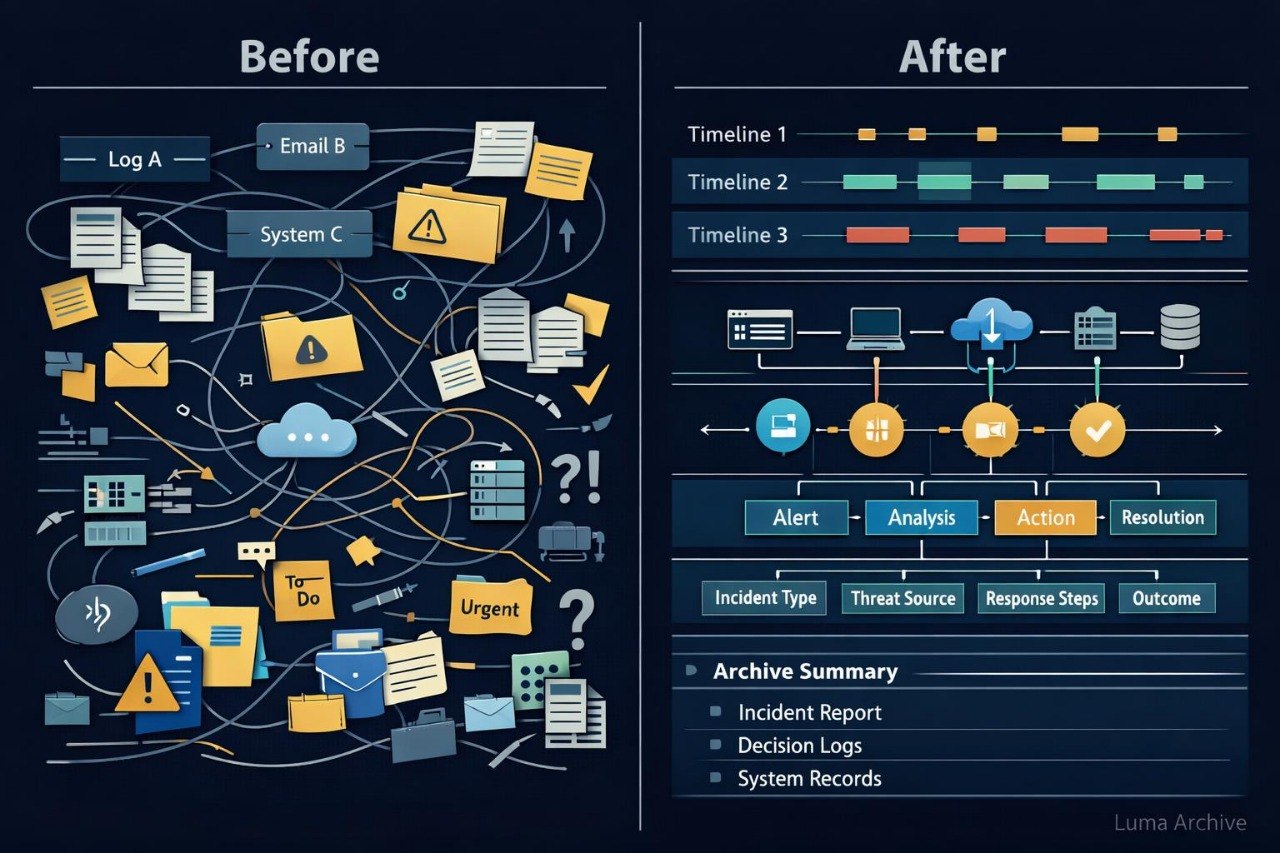
This course will teach you how to examine complex digital scenarios from the initial record through the closing review. You will study ways to combine information, compare timelines, assess sources, and build relationship maps. The materials explain how to define analysis boundaries and separate confirmed facts from working assumptions. Practical assignments provide experience with large record collections while preserving important context. At the end of the course, you will prepare a structured learning-incident archive containing tables, diagrams, conclusions, and recommendations for later review.
3. What’s Inside
Module 1: Complex Environment Overview
You will learn how to define the boundaries of a digital environment and identify the objects relevant to an analysis. The module covers people, accounts, information, devices, transfer channels, and related actions.
Module 2: Structured Information Intake
Learners create an initial information collection form. It records the source, time, event description, connected objects, current status, and questions requiring additional examination.
Module 3: Record Quality Review
This module explains how to assess record completeness, accuracy, origin, and relevance. You will learn to mark missing fields, contradictions, and unconfirmed statements.
Module 4: Timeline Synchronization
You will work with several parallel timelines. Exercises help compare events, identify time gaps, and determine which records may describe the same episode.
Module 5: Entity Relationship Analysis
Learners create a map connecting people, information, accounts, messages, and actions. Each relationship is marked as direct, indirect, or requiring further examination.
Module 6: Data Flow Examination
This module focuses on information movement between different points in a digital environment. You will identify where data is created, changed, transferred, stored, and reviewed.
Module 7: Pattern and Deviation Review
You will compare ordinary activity with unusual changes. The materials help assess repetition, context, and possible impact without reaching early conclusions.
Module 8: Scope and Priority Decisions
Learners establish criteria for defining analysis boundaries. You will separate relevant materials from secondary information and classify events by attention level.
Module 9: Documentation Language
This module covers precise and neutral wording for digital event records. You will practice describing confirmed information, unresolved questions, completed actions, and analysis limitations.
Module 10: Response Process Mapping
You will create an action map covering the period from event identification to closing review. The framework includes decision points, assigned roles, required records, and information handover steps.
Module 11: Archive Assembly and Review
Learners combine tables, timelines, relationship maps, and written summaries into one organized structure. A separate section covers the review of names, statuses, sources, and connected materials.
Module 12: Luma Integrated Case
The closing module contains an extended learning scenario with several participants, sources, and event sequences. You will organize the materials, identify central relationships, prepare documentation, and create a closing archive review.
4. Who Is This For?
✅ This plan is suitable if you:
- already understand foundational cybersecurity principles;
- want to work with complex connected scenarios;
- are prepared to examine tables, diagrams, and large record collections;
- want to develop digital event documentation skills;
- want to create organized timelines and relationship maps;
- value detailed practical assignments.
❌ This plan may not suit you if you:
- are beginning your first introduction to the subject;
- do not intend to complete analytical assignments;
- are seeking instructions for conducting digital attacks;
- require materials about harmful code development;
- expect only a brief list of general recommendations;
- are looking for employment claims or predetermined outcomes.
5. What You’ll Learn
After completing the materials, you will be able to:
- define the boundaries of a complex digital environment;
- organize records from six or more sources;
- assess information using four quality criteria;
- synchronize three connected timelines;
- create a relationship map containing twenty or more objects;
- describe information movement between key points;
- identify recurring signals and unusual changes;
- classify events by attention level;
- prepare a neutral written review;
- create a process map containing decision points;
- examine documentation completeness with a checklist;
- prepare a finished archive for a complex learning scenario.
6. Payment and Refund Terms
A refund request for Luma Archive may be submitted within 30 calendar days of purchase. Each request is reviewed according to the conditions published on the store’s Refund Policy page. Learners should review the course structure, included materials, and current purchase terms before placing an order.
7. Certificate
After completing all twelve modules and the required knowledge checks, the learner receives a digital Luma Archive certificate. The document records the course title and completion date.
What format do the courses use?
What format do the courses use?
Klyvara courses contain sequential modules, written explanations, diagrams, learning scenarios, knowledge checks, and practical tasks. The exact materials depend on the selected plan and are listed on its page.
Do I need previous cybersecurity knowledge?
Do I need previous cybersecurity knowledge?
Previous preparation is not required for introductory plans. The materials begin with foundational concepts and gradually move toward digital risk analysis, information protection, and responses to suspicious events.
How long does a course take?
How long does a course take?
Each learner chooses their own study pace. Modules can be reviewed separately, previous explanations can be revisited, and learning tasks can be completed again when needed.
Is a certificate provided?
Is a certificate provided?
Yes. A certificate of completion is provided after all modules and required knowledge checks have been completed. It includes the course title and completion date.
Share