Klyvara
Vertex Archive
Vertex Archive
Couldn't load pickup availability
Self-paced learning overview
- 📥 Digital file available after purchase
- ♾️ Long-term availability
- 🔒 Secure checkout
- 🗓️ Content updated in 2026
1. Problem Statement
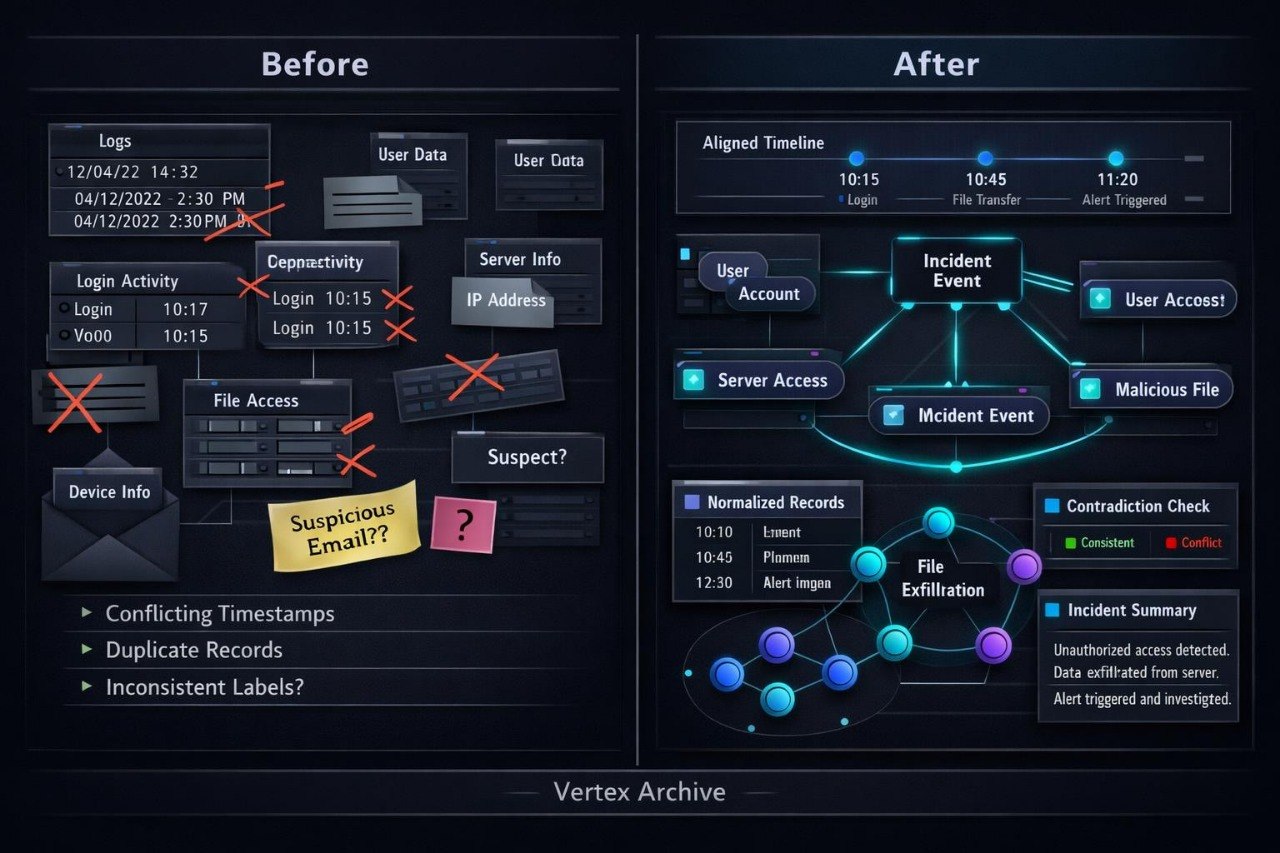
Struggling to identify the central point of an event when information comes from several sources and contains conflicting details? You’re not alone: records describing the same situation may use different timestamps, names, statuses, and descriptions. Some details may be repeated, while other meaningful elements remain unnoticed. Without a consistent method, analysis can become a review of isolated facts rather than an examination of their relationships. Preparing a useful summary requires organized materials, record-quality assessment, and careful reconstruction of the event sequence.
2. Solution
This course will teach you how to examine multi-layered digital scenarios and connect records from different sources. You will study data normalization, timestamp comparison, and the classification of primary and supporting events. The materials explain how to evaluate record quality and document contradictions without unsupported conclusions. Practical tasks involve relationship maps, event tables, and structured reviews. In the closing assignment, you will prepare a complete archive for a complex learning incident.
3. What’s Inside
Module 1: Multi-Source Record Review
You will learn how to examine information collected from several sources. The module explains how to identify duplicates, differences, missing fields, and records requiring additional clarification.
Module 2: Data Normalization
Learners bring different date formats, names, statuses, and categories into one consistent structure. You will create a rule table for organizing every record in the scenario.
Module 3: Record Reliability Assessment
This module focuses on record completeness, origin, and relevance. You will distinguish confirmed information, indirect observations, and unverified assumptions.
Module 4: Advanced Timeline Alignment
You will work with parallel timelines and events recorded in different time formats. Exercises help establish the correct sequence and mark periods where information is missing.
Module 5: Entity and Relationship Mapping
Learners create a map connecting people, accounts, devices, files, messages, and actions. The module explains how to separate direct relationships from connections requiring further review.
Module 6: Event Clustering
You will organize records into groups based on timing, source, behavior, and possible impact. The practical section contains several event collections that must be divided into logical categories.
Module 7: Contradiction Resolution
This module covers conflicting descriptions and timestamps. You will prepare a discrepancy table and identify questions that need additional clarification.
Module 8: Priority and Scope Review
You will examine how to define analysis boundaries and remove unrelated materials. Learners create priority criteria for events, records, and open questions.
Module 9: Structured Incident Narrative
This module helps convert tables and diagrams into a coherent written account. You will learn to present events neutrally while separating facts, conclusions, and questions requiring later review.
Module 10: Archive Review Procedure
Learners create a process for checking archive completeness. It covers names, categories, timestamps, sources, statuses, and connected documents.
Module 11: Vertex Case Exercise
In the final assignment, you will examine a large collection of fragmented materials. You will normalize records, build timelines, create a relationship map, and prepare a closing review.
4. Who Is This For?
✅ This plan is suitable if you:
- have already worked with foundational event maps and timelines;
- want to examine large collections of connected records;
- want to organize conflicting information;
- are prepared to complete detailed analytical tasks;
- want to develop digital event documentation skills.
❌ This plan may not suit you if you:
- are beginning your cybersecurity studies;
- do not intend to work with tables and diagrams;
- are seeking instructions for conducting attacks;
- require materials about harmful code development;
- are looking for employment claims or predetermined outcomes.
5. What You’ll Learn
After completing the materials, you will be able to:
- combine records from five or more sources;
- normalize at least twenty information elements;
- evaluate records using four reliability criteria;
- build several connected timelines;
- create a map containing fifteen or more entities;
- organize events into logical groups;
- prepare a contradiction table;
- define analysis boundaries and priorities;
- write a structured account of a complex incident;
- review archive completeness using a personal checklist;
- prepare a complete learning archive.
6. Payment and Refund Terms
A refund request for Vertex Archive may be submitted within 30 calendar days of purchase. Each request is reviewed according to the conditions published on the store’s Refund Policy page. Learners should review the module descriptions, material format, and current purchase terms before placing an order.
7. Certificate
After completing all eleven modules and the required knowledge checks, the learner receives a digital Vertex Archive certificate. The document records the course title and completion date.
What format do the courses use?
What format do the courses use?
Klyvara courses contain sequential modules, written explanations, diagrams, learning scenarios, knowledge checks, and practical tasks. The exact materials depend on the selected plan and are listed on its page.
Do I need previous cybersecurity knowledge?
Do I need previous cybersecurity knowledge?
Previous preparation is not required for introductory plans. The materials begin with foundational concepts and gradually move toward digital risk analysis, information protection, and responses to suspicious events.
How long does a course take?
How long does a course take?
Each learner chooses their own study pace. Modules can be reviewed separately, previous explanations can be revisited, and learning tasks can be completed again when needed.
Is a certificate provided?
Is a certificate provided?
Yes. A certificate of completion is provided after all modules and required knowledge checks have been completed. It includes the course title and completion date.
Share